The Simulation Loop
A simulation is the imitation of the operation of a real-world process or system over time.
(Banks et al. 2001, p. 3)
Machwave's simulation loop takes a motor model plus a set of simulation parameters, iterates the motor state over time in fixed timesteps, and returns the time history of the run.
%%{init: {"flowchart": {"nodeSpacing": 20, "rankSpacing": 40, "padding": 6, "subGraphTitleMargin": {"top": 4, "bottom": 4}}}}%%
flowchart LR
    subgraph Input
        direction LR
        P["Simulation parameters"]
        M["Motor model"]
    end
    subgraph Loop["Simulation loop"]
        direction TB
        S["1. Create the motor state"] --> A["2. Advance the timestep"]
        A --> C["3. Evaluate stop criteria"]
        C -- not met --> A
    end
    subgraph Output
        direction LR
        T["Time series<br/>thrust, chamber pressure"]
        G["Aggregate parameters<br/>specific impulse"]
    end
    Input --> Loop
Loop --> OutputInputs
The Motor model is the physical description of the motor/engine: propellant, grain, feed system, thrust chamber, and more.
By design, it does not change during a run and no simulation state is stored in it.
The simulation parameters (InternalBallisticsSimulationParams) set the conditions of the run.
These parameters are common to every motor type, be it solid, biliquid, or other.
They are:
- Timestep: the fixed time interval between two state evaluations [s].
- Igniter pressure: the chamber pressure at the start of the run [Pa]. The ignition transient is not modeled, so the run starts with the chamber already pressurized.
- External pressure: the ambient pressure, held constant for the whole run [Pa]. The trajectory is not modeled, so altitude changes during the burn are not accounted for.
The Simulation Class
The class InternalBallisticsSimulation runs the loop shown above.
It creates the state class matching the motor type, advances it one timestep at a time until the state reports that the run is over, and returns the result.
It holds no physics and no stop logic of its own: the state decides both what a timestep computes and when the run ends.
The State Class
The motor state is what changes during a run: the time, the chamber pressure the propellant properties, and more.
There is one state class per motor type, SolidMotorState, BiliquidEngineState, and so on, all extending MotorState.
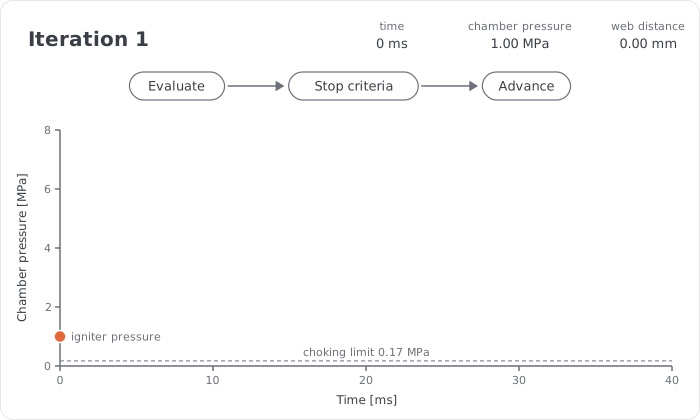
Each timestep, the state evaluates the motor at the current chamber pressure, records the operating point, and advances to the next timestep.
It also decides when the run is over: once the stop criteria is met it sets end_thrust to True, and the simulation stops advancing.
Stop Criteria
The stop criteria decide when the run is over.
They are evaluated by the state, not by the simulation. MotorState checks them once per timestep, after the iteration is evaluated, and sets end_thrust to True once one is met.
Since the check lives in the base class, every motor type stops on the same criteria.
The run ends on the first of two conditions:
- Loss of choking: the chamber pressure falls below the external pressure divided by the critical pressure ratio.
- Tail-off: the motor has no propellant able to burn and the thrust has decayed to 0.1% of its peak.
Outputs
The state is frozen into a SimulationResult instance.
It contains time series such as thrust and chamber pressure, as well as aggregated metrics such as total impulse and specific impulse.
Every motor type extends the abstract class: SolidSimulationResult, BiliquidSimulationResult, and so on.
References
- Banks, J., Carson, J. S., Nelson, B. L., & Nicol, D. M. (2001). Discrete-Event System Simulation (3rd ed.). Prentice Hall.